
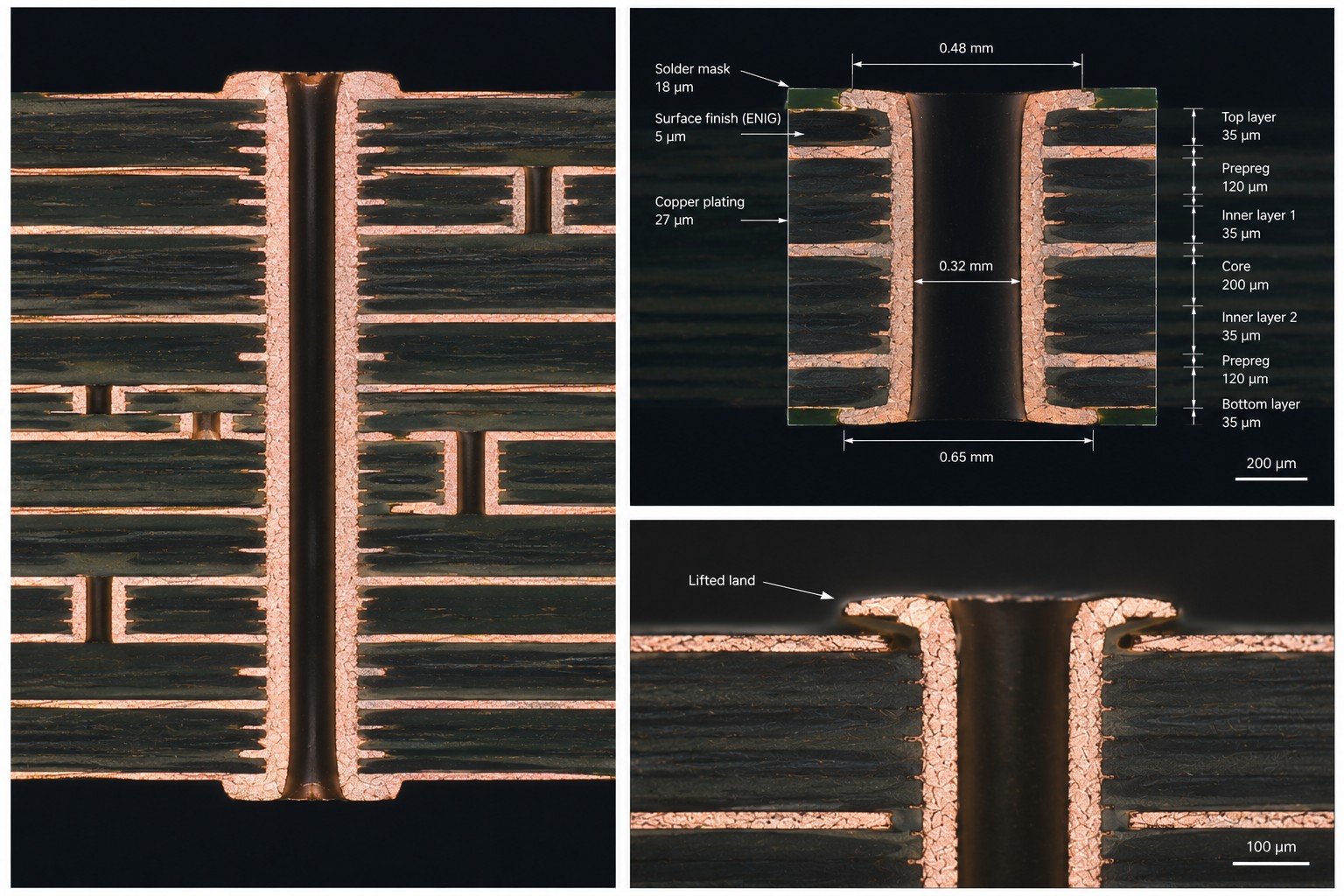
The service documents internal PCB conditions by cross-section analysis. It can include evaluation of via and plated-through-hole quality, copper plating thickness, inner-layer connections, layer registration, PCB stack-up construction, dielectric spacing, solder mask build-up, laminate quality and visible defects. The scope is focused on the internal construction that can be documented from the cross-section itself.
Electronic product compliance
PCB cross-section analysis for failure analysis and quality review
Document the internal construction of the PCB to support qualification, release, failure investigation and evaluation against specifications.
PCB cross-section analysis is relevant when a PCB fails, shows unexpected behaviour, must be evaluated before release, is being qualified with new PCB suppliers, or customer requirements must be verified. Surface inspection only shows the outside, and supplier declarations cannot document the PCB’s internal construction.
What the analysis documents
The analysis provides a documented basis for assessing internal features, including via and plated-through-hole quality, copper plating thickness, inner-layer connections, layer registration, PCB stack-up construction, dielectric spacing, solder mask build-up, laminate quality and visible defects. Without objective documentation, quality issues can lead to delayed releases, repeated failures, supplier disputes and unnecessary corrective actions.
Used across demanding electronics applications
PCB cross-section analysis is widely used in aerospace and defence, automotive electronics, medical devices, industrial electronics, maritime and offshore systems, and power electronics, where documented insight into internal PCB construction supports technical evaluation and quality-related decisions.
Challenges
When the PCB’s internal construction cannot be verified, release, investigation and quality decisions are delayed.
Hidden internal conditions delay release
When PCB construction cannot be documented, it becomes difficult to determine whether the board is ready for production release or meets the agreed requirements. This can delay release decisions and create uncertainty around the next step.
Unclear failure mechanisms prolong investigations
If internal connections, plating or spacing cannot be examined, field failures and unexpected behaviour are harder to investigate. The lack of objective evidence makes it more difficult to identify the relevant cause and focus corrective actions.
Missing facts complicate supplier and customer dialogue
When quality concerns are based solely on surface inspection or declarations, discussions about PCB quality become harder to resolve. This can prolong complaint handling and make supplier qualification or specification review more difficult.
Benefits